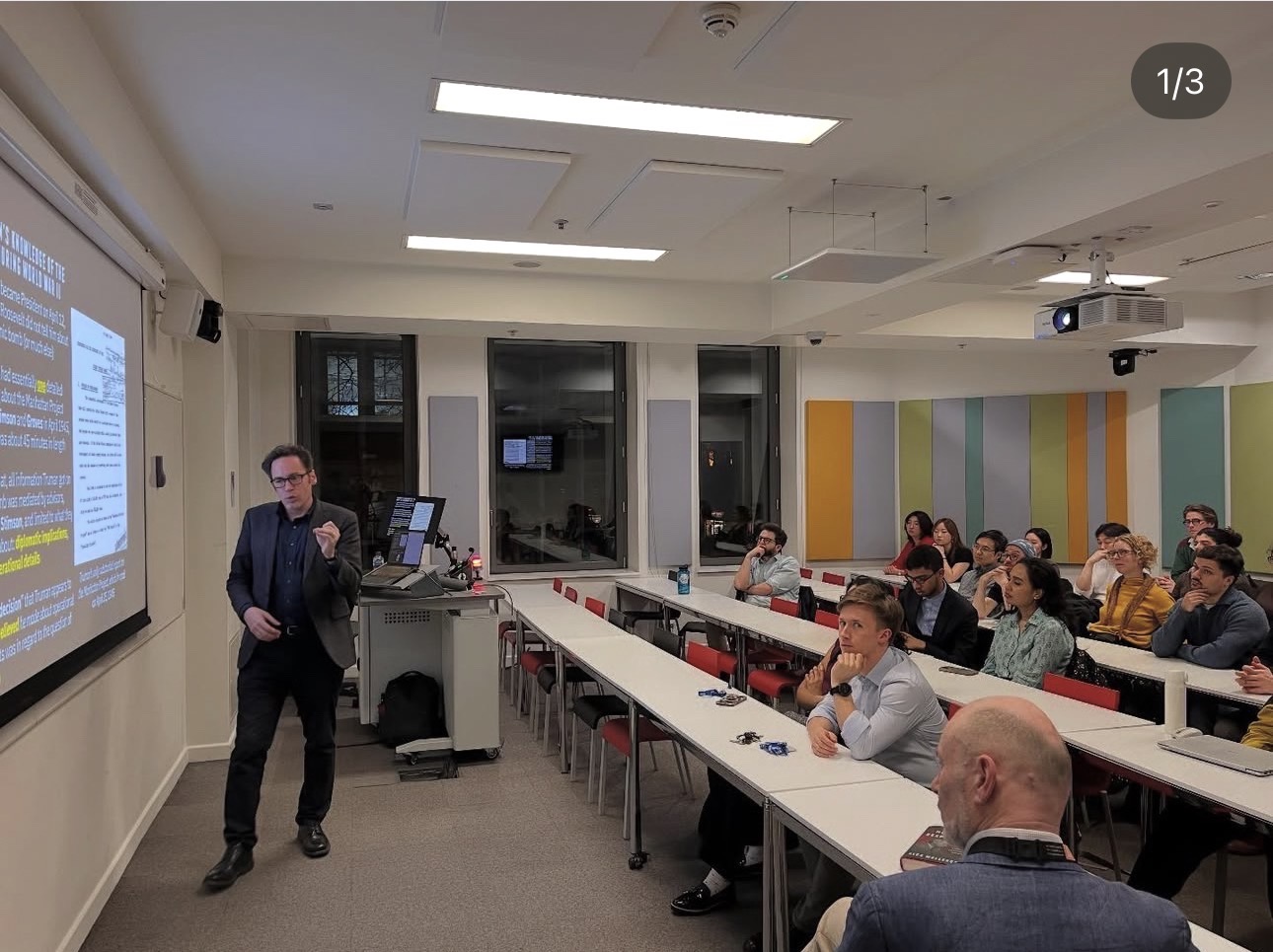
I recently attended a lecture at the London School of Economics by Dr Alex Wellerstein, titled “The Most Awful Responsibility: Truman and the Secret Struggle for Control of the Atomic Age.” The main argument of the talk really surprised me. Wellerstein argued that even though Truman is usually remembered as the president who used the atomic bomb, he was probably the most anti-nuclear president of the twentieth century. That sounds like a contradiction, but the lecture went through the evidence step by step to show why.
The starting point was a quote from Truman himself, which the lecture treated as a kind of summary of how he came to view the bomb. He described it as the most terrible of all destructive forces, used for the wholesale slaughter of human beings, including women, children and unarmed people, not for military purposes, and said it must never happen again. Wellerstein said that his primary association with the atomic bomb after Hiroshima was one of deep moral abhorrence. That was important because it sets up the whole argument. If Truman really felt that, then his role looks more conflicted than the standard story suggests.
The first thing Wellerstein did was deal with the usual counter-arguments. People often say Truman ordered the use of the atomic bomb twice, ordered the building of the hydrogen bomb, and was praised by critics as the first Cold War president, and so he must have been pro-nuclear. The lecture pushed back on this by showing that the decision-making about the bomb was mostly peripheral to Truman himself. The actual choices were made by Leslie Groves, the Secretary of War Henry Stimson, and committees like the Target Committee and the Interim Committee. Groves himself characterised Truman’s role as non-interference. That was new to me, because in school the bomb is usually presented as Truman’s decision.
One reason the decisions were so peripheral was that Truman knew very little about the bomb before becoming president in 1945. His only real exposure before that was one detailed 45-minute briefing about the Manhattan Project from Stimson and Groves. After that, all the information he got was mediated by advisors, mostly Stimson, and was limited to diplomatic implications rather than operational details. So even as president, he was not really involved in the operational side.
The one big exception was Kyoto. This was where Truman did get involved, and the lecture used it as a case study. Groves and the Target Committee originally chose Kyoto as the number one preferred target in May 1945, with Hiroshima as number two. Stimson vehemently vetoed Kyoto as a target. Groves did not really respect that and called it interference, and he tried multiple times to restore Kyoto on the list. As the target list was being finalised in late July 1945, he tried again. At Potsdam, Stimson went to Truman to get his authority on removing Kyoto, and Truman agreed with him. So this is the moment where Truman actually intervened, and it was a moral and cultural intervention rather than a military one.
Wellerstein then went through the timeline of the bombing itself. The Trinity test of the “Gadget” took place on 16 July, a plutonium implosion device. “Fat Man” was used on 9 August, also a plutonium implosion. One detail that really stood out to me was that it was only on 8 August, when the clouds from the first bomb slightly parted, that Truman realised Hiroshima was a city. There was supposed to be a third bomb, but the immediate response was an order to stop atomic bombing because of further moralistic consequences for the president. Even though Truman took all responsibility for the bombings publicly, the lecture argued that his real decision-making had been peripheral throughout.
The strongest part of the argument came after the war. In late 1945, Truman withdrew his support for the military’s Atomic Energy Act Bill and made civilian control and presidential oversight major requirements for future atomic policy. In 1947, after the military lost custody of atomic bombs to the US Atomic Energy Commission, Truman refused to restore it. Compared to Eisenhower later on, he gave the Department of Defence very little atomic weaponry. Wellerstein argued that this stance was heartfelt and based on a fear that military control would lead to nuclear weapons being used. Truman took on the responsibility of making sure Hiroshima and Nagasaki would never happen again, and the way he did it was by centralising authority in the presidency. For me, this is what genuinely changed how I saw him. After 1945, his actions look like someone trying to stop the bomb from ever being used again, not someone embracing it.
The other point I had not really thought about was that Truman was not very anti-Soviet until 1950. Before then, he did not subscribe to standard Cold War mindsets and believed in demilitarisation and trying to understand the Soviets. It was only with the onset of the Korean War that he started to consider nuclear buildup at all. And after the Second World War, he never actually considered using nuclear weaponry in conflict. So even when his rhetoric eventually hardened, his actual position on use never did.
Overall, the lecture changed my view of Truman more than I expected. The familiar image is of the man who dropped the bomb. The picture Wellerstein gave was of a president who was kept out of the operational decision-making, intervened only when something like Kyoto came up, took public responsibility for everything that happened, and then spent the rest of his presidency trying to stop it from happening again. He still bears responsibility because he was president, and the bombings did happen on his watch. But the case that he was, in practice, the most anti-nuclear president of the twentieth century is more convincing than I would have thought before going in. The most useful thing I took from the talk was that responsibility and authorship are not always the same thing in history. Knowing who actually made a decision matters as much as knowing who is remembered for it.