Historical Reflection
Focus: How does the daily Beating Retreat ceremony at Attari-Wagah transform the memory of Partition into a nationalist spectacle?
The Attari-Wagah Border: Defiance Through Celebration
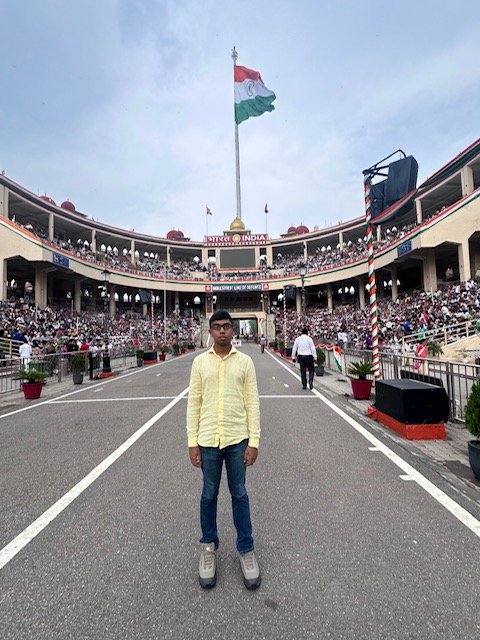
Standing in the concrete amphitheatre of the Attari-Wagah border on August 14th, 2026, the sheer weight of historical irony could be felt in the air I breathed. The date carries an immense, painful significance, for it is the literal eve of India’s Independence, but simultaneously the anniversary of Pakistan’s creation. This specific temporal fault line charges the atmosphere with a volatile and emotional current. For me, the daily Beating Retreat ceremony here transcends its function as a military drill, operating as a meticulously engineered lieu de mémoire (conceptualised by historian Pierre Nora.) Rather than allowing the physical border to stand as a somber monument to the tragic displacement of 15 million people in 1947, the post-colonial state has transformed this geopolitical scar into a theatre of competitive nationalism, where collective memory was weaponised.
The audience is not a collection of passive observers; we were actively engineered into a performing mass, a collective body validating the state's consensus through synchronised cheers. The deafening barrage of patriotic pop music and orchestrated crowd leaders chanting slogans functioned as a psychological buffer, effectively drowning out any quiet, uncomfortable reflection on the shared past of the two sides.
Established in the wake of the 1965 Indo-Pakistani War, the Border Security Force (BSF) is mythologised at Attari as India's “First Line of Defence.” Watching the ceremony unfold on this specific anniversary highlighted how the state constructs a permanent psychology of siege. The BSF’s high-stepping, aggressive drills, the violent stomping of boots and the exaggerated, fierce facial and physical gestures operate as a highly stylised form of simulated combat. This ritualised aggression serves a crucial function, externalising the threat of the neighbor across the gate while internally comforting the domestic populace of their absolute protection. By elevating these border guards to a status of hyper-visible, theatrical guardianship on the eve of Independence Day, the state effectively weaponises the memory of past conflicts to justify the ongoing, everyday militarisation of the frontier, metamorphosing historical trauma into a justified, permanent state of high alert.
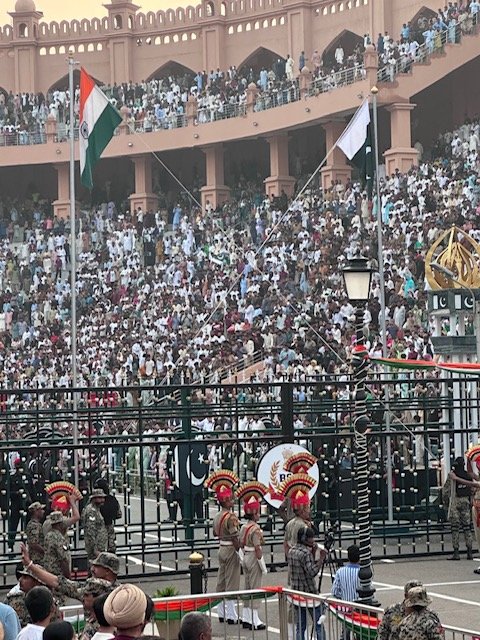
Within the ceremony, there was an ideological shift that felt particularly stark during my visit: the prominent showcase of women and children, and the integration of female BSF officers into the parade. Historically, this border was an exclusively hyper-masculine space of raw physical intimidation. Today, the state actively co-opts gender to signal a modern, progressive identity. Before the formal military parade began, I watched civilian women and children from the crowd being invited down from the stands onto the tarmac of the Grand Trunk Road to run with the national flag and dance to patriotic music. By positioning women and children at the physical threshold of the nation, the state visually links the vulnerability of the domestic sphere with the sanctity of the geographical border. Furthermore, the deliberate inclusion of children ensures the generational transmission of this curated animosity, embedding the border ritual into the formative memory of the youth.
The induction of women into the BSF infantry and their subsequent deployment in the Beating Retreat drill adds another layer of post-colonial competition to this site. India utilises its female guards to project an image of a secular, liberal and egalitarian democracy, directly contrasting itself with the visibly more conservative, male-dominated presentation of the Pakistani Rangers across the gate. However, as a history student, this representation strikes me as deeply paradoxical. While it superficially disrupts the historical trend of male-only militarism, it actually co-opts the female form into the same patriarchal, aggressive structures of state violence and competitive nationalism that personified the border's bloody creation. The female officers stomp just as fiercely and glare just as intensely, absorbed completely into the martial state apparatus.
Ultimately, my experience at the Attari-Wagah border on August 14th demonstrated how a site can become a lieu de mémoire not to preserve history, but to rewrite it. Pierre Nora argued that lieux de mémoire arise because there are no longer any real environments of memory (milieux de mémoire); we build monuments because we are forgetting the lived reality. The Attari ritual completely sanitises the visceral trauma of Partition, the horrific communal slaughter, the mass abductions of women and the painful splintering of families. In its place, the state has substituted a celebratory spectacle of the border itself, no longer to be remembered as a profound tragedy of political failure and human suffering. Instead, through this daily performance, it is celebrated as a triumphant monument of state sovereignty and resilience. By turning the memory of Partition into a recurring spectacle of defiance, the state ensures that the historical wound is never allowed to heal into shared regional peace, but is instead kept open, feeding the geopolitical necessities of the modern national security state.